Vergence and the vergence equation
= object and image vergence (D); = object and image distance (m); = index of the object and image media; = power of the lens or surface (D)
The optics and vision science formulas for NBEO Part I, grouped by the areas of the NBEO content outline with the most scored items first. Every formula names the textbook chapter it comes from.
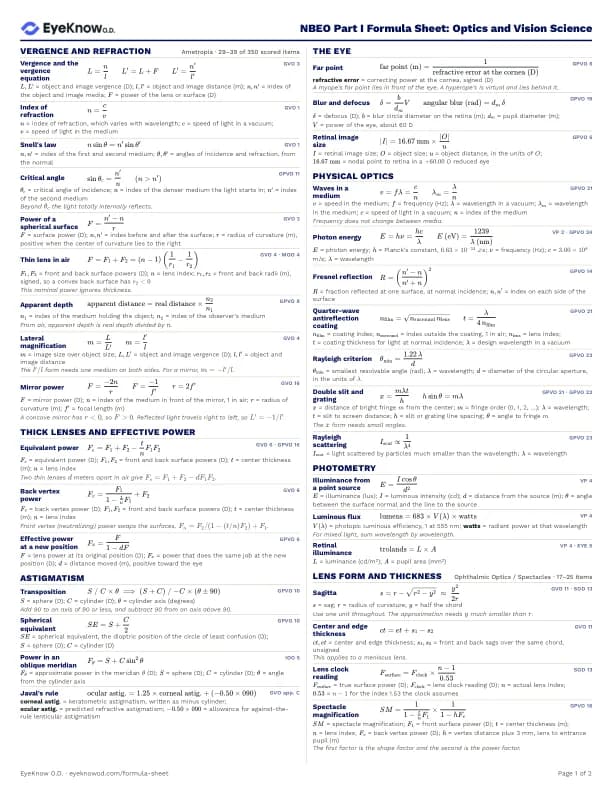
The optics and vision science formulas on one printable sheet, front and back. Every symbol is defined with its units, and every formula names its textbook chapter.
Ametropia · 29–39 of 350 scored items
= object and image vergence (D); = object and image distance (m); = index of the object and image media; = power of the lens or surface (D)
= index of refraction, which varies with wavelength; = speed of light in a vacuum; = speed of light in the medium
= index of the first and second medium; = angles of incidence and refraction, from the normal
= critical angle of incidence; = index of the denser medium the light starts in; = index of the second medium
Beyond the light totally internally reflects.
= surface power (D); = index before and after the surface; = radius of curvature (m), positive when the center of curvature lies to the right
= front and back surface powers (D); = lens index; = front and back radii (m), signed, so a convex back surface has
This nominal power ignores thickness.
= index of the medium holding the object; = index of the observer's medium
From air, apparent depth is real depth divided by .
= image size over object size; = object and image vergence (D); = object and image distance
The form needs one medium on both sides. For a mirror, .
= mirror power (D); = index of the medium in front of the mirror, 1 in air; = radius of curvature (m); = focal length (m)
A concave mirror has , so . Reflected light travels right to left, so .
= equivalent power (D); = front and back surface powers (D); = center thickness (m); = lens index
Two thin lenses meters apart in air give .
= back vertex power (D); = front and back surface powers (D); = center thickness (m); = lens index
Front vertex (neutralizing) power swaps the surfaces, .
= lens power at its original position (D); = power that does the same job at the new position (D); = distance moved (m), positive toward the eye
= sphere (D); = cylinder (D); = cylinder axis (degrees)
Add 90 to an axis of 90 or less, and subtract 90 from an axis above 90.
= spherical equivalent, the dioptric position of the circle of least confusion (D); = sphere (D); = cylinder (D)
= approximate power in the meridian (D); = sphere (D); = cylinder (D); = angle from the cylinder axis
corneal astig. = keratometric astigmatism, written as minus cylinder; ocular astig. = predicted refractive astigmatism; = allowance for against-the-rule lenticular astigmatism
refractive error = correcting power at the cornea, signed (D)
A myope's far point lies in front of the eye. A hyperope's is virtual and lies behind it.
= defocus (D); = blur circle diameter on the retina (m); = pupil diameter (m); = power of the eye, about 60 D
= retinal image size; = object size; = object distance, in the units of ; = nodal point to retina in a D reduced eye
= speed in the medium; = frequency (Hz); = wavelength in a vacuum; = wavelength in the medium; = speed of light in a vacuum; = index of the medium
Frequency does not change between media.
= photon energy; = Planck's constant, J·s; = frequency (Hz); = m/s; = wavelength
= fraction reflected at one surface, at normal incidence; = index on each side of the surface
= coating index; = index outside the coating, 1 in air; = lens index; = coating thickness for light at normal incidence; = design wavelength in a vacuum
= smallest resolvable angle (rad); = wavelength; = diameter of the circular aperture, in the units of
= distance of bright fringe from the center; = fringe order (0, 1, 2, …); = wavelength; = slit to screen distance; = slit or grating line spacing; = angle to fringe
The form needs small angles.
= light scattered by particles much smaller than the wavelength; = wavelength
= illuminance (lux); = luminous intensity (cd); = distance from the source (m); = angle between the surface normal and the line to the source
= photopic luminous efficiency, 1 at 555 nm; watts = radiant power at that wavelength
For mixed light, sum wavelength by wavelength.
= luminance (cd/m²); = pupil area (mm²)
Ophthalmic Optics / Spectacles · 17–25 items
= sag; = radius of curvature; = half the chord
Use one unit throughout. The approximation needs much smaller than .
= center and edge thickness; = front and back sags over the same chord, unsigned
This applies to a meniscus lens.
= true surface power (D); = lens clock reading (D); = actual lens index; = for the index 1.53 the clock assumes
= spectacle magnification; = front surface power (D); = center thickness (m); = lens index; = back vertex power (D); = vertex distance plus 3 mm, lens to entrance pupil (m)
The first factor is the shape factor and the second is the power factor.
= prism power (); = angle of deviation
= minimum angle of deviation; = apex angle, under about 10°, in the units of ; = prism index
= induced prism (prism diopters); = distance from the optical center (cm); = lens power in that meridian (D)
= decentration (cm); = prism wanted (prism diopters); = lens power in that meridian (D)
Decenter a plus lens toward the base you want and a minus lens away from it.
= oblique prism to resolve (); = base direction, 360° notation; = horizontal and vertical components (); = prism that combines and
Find without signs, then set the quadrant: I , II , III , IV .
= thickness difference, base to apex; = prism power (prism diopters); = lens size along the base-apex line, and takes its units; = lens index
= vertical imbalance (); = drop from the distance optical centers to the reading level (cm); = power in the 90° meridian, signed (D); = that power for the right and left lens; = each lens's prescription
= seg top to seg optical center (cm), half the diameter for a round seg; add = add power (D)
Distance power does not change jump.
= Abbe value; = index at 587.6, 486.1 and 656.3 nm; TCA = transverse chromatic aberration (); = distance from the optical center (cm); = lens power (D)
= transmitted intensity; = intensity of the already polarized incident light; = angle between its polarization and the transmission axis
An ideal polarizer passes 50% of unpolarized light.
= angle of incidence at which the reflected light is fully polarized; = index of the medium the light comes from; = index of the reflecting medium
Accommodation / Vergence / Oculomotor Function · 10–18 items
= amplitude of accommodation (D); = far point and near point vergences at the cornea (D)
age = age in years; = expected minimum, average and maximum amplitude (D)
working distance = near working distance (m), unsigned; amplitude = push-up amplitude (D)
Refine the add by balancing NRA and PRA.
MA = meter angles; = fixation distance (m); PD = interpupillary distance (cm); = convergence demand (prism diopters)
AC/A = accommodative convergence per diopter of accommodation (/D); PD = interpupillary distance (cm); NFD = near fixation distance (m); = near and far phorias (), eso plus and exo minus
AC/A = accommodative convergence per diopter of accommodation (/D); phoria = in , eso plus and exo minus; lens power = the added lens, signed (D)
Perceptual Function / Color Vision · 10–18 items
MAR = minimum angle of resolution (arcmin)
A 20/20 letter subtends 5 arcmin, and its detail subtends 1 arcmin.
= peak and trough luminance; = target luminance minus background luminance; = background luminance
Use Michelson contrast for gratings and Weber contrast for a target on a uniform background.
= threshold increment; = background intensity; = Weber fraction, about 0.015 photopic and 0.14 scotopic
De Vries–Rose holds on very dim backgrounds and Weber on brighter ones.
= threshold intensity; = stimulus area; = a constant
It holds inside the critical diameter, about 10 arcmin scotopic and smaller photopic.
= threshold intensity; = stimulus duration; = a constant
It holds inside the critical duration, about 100 ms scotopic and 10 to 50 ms photopic.
CFF = critical flicker fusion frequency (Hz); = luminance; = constants
It holds only under photopic conditions, and rod flicker fusion stays near 20 Hz.
= tristimulus values; = chromaticity coordinates
The chromaticity diagram plots against .
Amblyopia / Strabismus · 9–17 items
= stereo threshold (rad), times 206,265 for arcsec; = interpupillary distance; = depth interval; = viewing distance, in the units of and
Contact Lenses · 8–14 items
= corneal power (D); = anterior corneal radius (mm)
337.5 comes from the keratometric index, .
base curve = back optic zone radius, as power (D); flat K = flattest keratometry reading (D)
Steeper than K adds minus and flatter adds plus (SAM–FAP), about 0.25 D per 0.05 mm.
RA = residual astigmatism, what a spherical rigid lens leaves uncorrected; refractive astigmatism = cylinder in the refraction; corneal astigmatism = keratometric cylinder
Plain subtraction works when the axes match.
Lens / Cataract / IOL · 7–13 items
= IOL power for emmetropia (D); = lens constant; = axial length (mm); = average keratometry (D)
Low Vision · 5–9 items
= effective magnification (×); = magnifier power (D)
It assumes a 25 cm reference distance, with the object at the focal point.
= relative distance magnification; = original viewing distance; = new viewing distance
= angular magnification; = objective and eyepiece powers (D); = tube length (m)
A Galilean () gives and an erect image.
numerator, denominator = of the best-corrected distance Snellen acuity
For standard print, 20/200 gives D.
Item ranges are from the NBEO’s Part I ABS discipline-based content outline. For practice with these formulas, the first half of Exam 1 is free.